Framework Overview
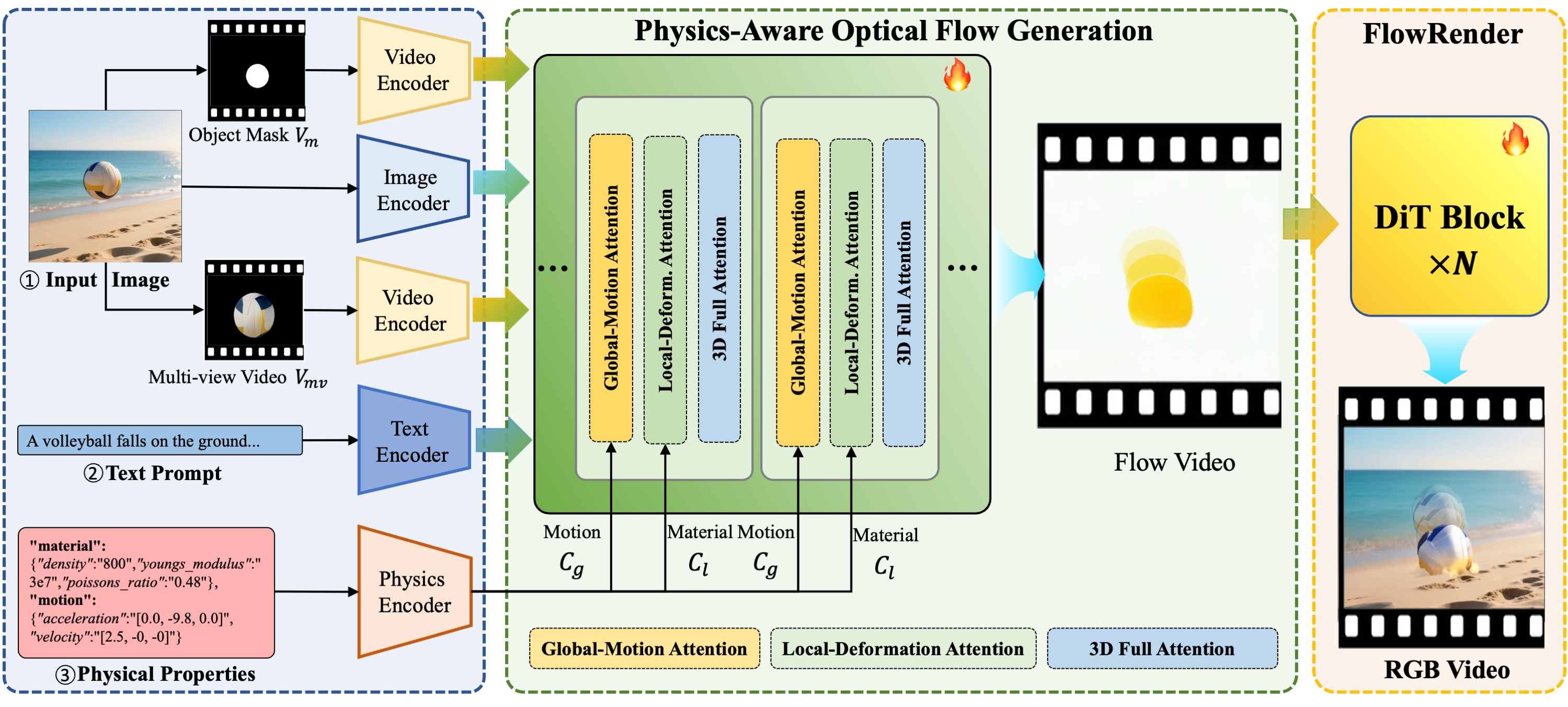
Video generation models have recently attracted substantial attention for their ability to generate visually compelling videos, yet ensuring physically consistent and plausible dynamics still remains a fundamental challenge, driving a growing line of research on physical realism in video generation. To address this challenge, motivated by the fact that physical regularities are primarily encoded in motion patterns, we propose PhysFlow, a novel two-stage framework for improving the physical plausibility of generated videos by decomposing video generation into motion-aware optical flow generation followed by motion-conditioned appearance synthesis. Specifically, PhysFlow consists of a physics-aware optical-flow video generator called PA-Flow and a flow-guided video generator called FlowRender. During the first stage, PA-Flow employs a physics-aware attention module to model how motion attributes and material properties influence global motion and local deformation, respectively, and generates an optical flow video as an explicit representation of motion. In the second stage, FlowRender leverages the decoupled motion representation as guidance to synthesize realistic textures and appearances, ultimately producing the final physically plausible video. To further support model training with explicit physical supervision, we construct PhysVideo, a physics-based video dataset generated with a physics engine and 3D-GS rendering, containing 10K foreground objects and 50K realistic video sequences with annotations of motion and material properties. Extensive experiments demonstrate that our proposed PhysFlow generates videos with superior physical plausibility while maintaining high visual fidelity compared with existing methods.
Qualitative comparison across diverse physical scenarios. Ours and PhysCtrl are highlighted.
Scene 1 — A toy dog falls onto the ground.
Ours
PhysCtrl
PhysGen3D
PhysGen
CogVideoX
Wan 2.2
Force Prompting
OmniPhysGS
Scene 2 — All balls fall onto the cushion.
Ours
PhysCtrl
PhysGen3D
PhysGen
CogVideoX
Wan 2.2
Force Prompting
OmniPhysGS
Scene 3 — A toy deer falls onto the ground.
Ours
PhysCtrl
PhysGen3D
PhysGen
CogVideoX
Wan 2.2
Force Prompting
OmniPhysGS
Scene 4 — A volleyball falls onto the ground.
Ours
PhysCtrl
PhysGen3D
PhysGen
CogVideoX
Wan 2.2
Force Prompting
OmniPhysGS
Scene 5 — Low-friction surface gliding.
Ours
PhysCtrl
PhysGen3D
PhysGen
CogVideoX
Wan 2.2
Force Prompting
OmniPhysGS
Scene 6 — Oblique two-object collision.
Ours
PhysCtrl
PhysGen3D
PhysGen
CogVideoX
Wan 2.2
Force Prompting
OmniPhysGS
Scene 7 — A basketball moves obliquely upward.
Ours
PhysCtrl
PhysGen3D
PhysGen
CogVideoX
Wan 2.2
Force Prompting
OmniPhysGS
Each case is shown side by side for direct visual comparison between Ours and PhysCtrl.
All toy dogs fall onto the ground.
Ours
PhysCtrl
All toy ducks fall into the water.
Ours
PhysCtrl
The leaves fall onto the ground.
Ours
PhysCtrl
A toy bear falls onto the sand pile.
Ours
PhysCtrl
A toy bear falls onto the sand pile.
Ours
PhysCtrl
A toy bear falls into the water.
Ours
PhysCtrl
Showcasing how PhysFlow responds to varying motion and material parameters.
Young's Modulus (E) Variation
Density (ρ) Variation
Hardness Variation
Additional qualitative results covering diverse motion patterns, multi-object interaction, physics-conditioned control, real-world scenarios, and optical flow visualizations on PhysVideo.
Sample clips from our physics-aware video dataset, used to train PA-Flow for plausible motion and material dynamics.